Camping Holiday Font Review
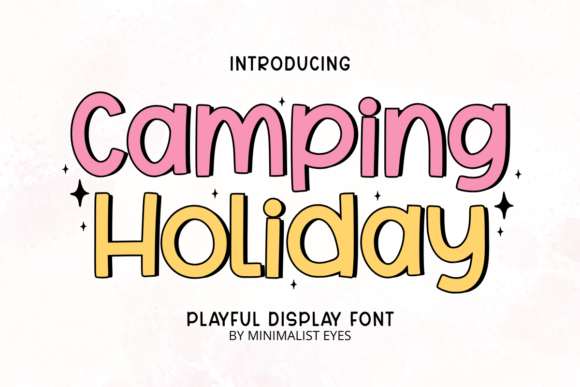
It was a quiet Tuesday morning, and I found myself staring at a blank brand board, trying to figure out how to make a new outdoor-themed café feel fresh and inviting. The client wanted something that felt like a weekend getaway—playful, energetic, and full of personality. That’s when I pulled up Camping Holiday, a vibrant Playful Display Font that is full of adventure and cheer. Its dual-layered structure—featuring a colored fill and a bold black outline—caught my eye immediately.
Camping Holiday for Logo Design and Brand Identity
Camping Holiday works best as a display font, especially when used in logo design and brand identity projects. I tested it on a logo concept for an eco-conscious café, and the result was exactly what the client needed: a visual that felt fun but still professional. The dual-layered look gives it a unique depth that stands out without being overwhelming. It’s not just a font—it’s a statement.
The font’s playful yet structured style makes it ideal for brands that want to convey a sense of adventure and warmth. Whether you’re working on a boutique identity or a creative studio, Camping Holiday adds a layer of character that can’t be replicated with more traditional typefaces. It’s perfect for short phrases, taglines, or any design element where boldness matters.
Camping Holiday for Packaging and Product Labels
I later tried Camping Holiday on a packaging mockup for a line of handmade soaps. The dual-layered effect made the product labels pop, especially when paired with bright colors. The bold black outline ensured readability even at smaller sizes, which is crucial for product labels that need to communicate quickly and clearly.
One thing to note is that while Camping Holiday shines in larger formats, it might not be the best choice for long body text or small print. But for packaging, it’s a solid choice. The font’s personality really comes through when placed on a product box, making it instantly recognizable and memorable.
Camping Holiday for Social Media Graphics and Web Headers
When I added Camping Holiday to a website header for a local restaurant, it brought a sense of energy and approachability. The font’s vibrant look worked well against a minimalist background, creating a strong visual contrast that drew attention. On social media, it made headlines and promotional posts stand out, especially when used with a colorful backdrop.
For web design, Camping Holiday is best used as a headline or accent font. It doesn’t hold up as well in paragraph form, but as a decorative element, it adds a level of creativity that can elevate a design. Pairing it with a clean sans serif font helps balance the overall look, ensuring the message remains clear and the design stays cohesive.
Camping Holiday for Business Cards and Print Materials
A quick test on a business card layout showed that Camping Holiday works well in print, especially when the text is kept short. The bold outline ensures legibility, even when printed in small sizes. I paired it with a simple serif font for the contact information, which created a nice contrast and helped maintain a professional tone.
For print materials like posters, flyers, and editorial designs, Camping Holiday can add a sense of movement and excitement. It’s not the best choice for formal or corporate branding, but for anything with a creative or casual vibe, it’s a great option. Just be mindful of spacing and line height to avoid clutter.
Camping Holiday for Brand Consistency and Visual Hierarchy
One of the most important aspects of using any font is maintaining brand consistency. Camping Holiday offers a strong visual identity that can help reinforce a brand’s message. Its bold and playful nature makes it ideal for creating visual hierarchy, drawing attention to key elements like headlines, logos, or call-to-action buttons.
However, it’s important to use it strategically. Overusing Camping Holiday can dilute its impact and make a design feel chaotic. A good rule of thumb is to use it as a primary or secondary headline font, rather than as the main body text. This keeps the design balanced and ensures the font’s strengths are highlighted.